How dealers use a standing wholesale buyer to clear aged inventory, absorb trade allowances, and free floor space without retailing.
Every forklift dealer has the same lot. Trade-ins taken to close a new-equipment sale, units that came in on allowance and do not fit the retail mix, aged inventory that has been reconditioned twice and still has not moved, and rental retirements that are too tired to keep on rent but too complete to scrap.
Individually these are minor. Collectively they tie up floor space, working capital, insurance, and technician hours that would earn more elsewhere. Most dealers know exactly which units these are and have known for months.
The math on aged inventory is unforgiving. Every additional month of holding costs money in space, capital, and periodic reconditioning, while the machine's market value continues to drift down. Retail effort spent on a hard-to-place trade is effort not spent on the new-equipment pipeline where the margin actually lives.
Auctions solve the space problem but introduce timing uncertainty, fees, and the risk of a no-sale that puts the unit right back where it started.
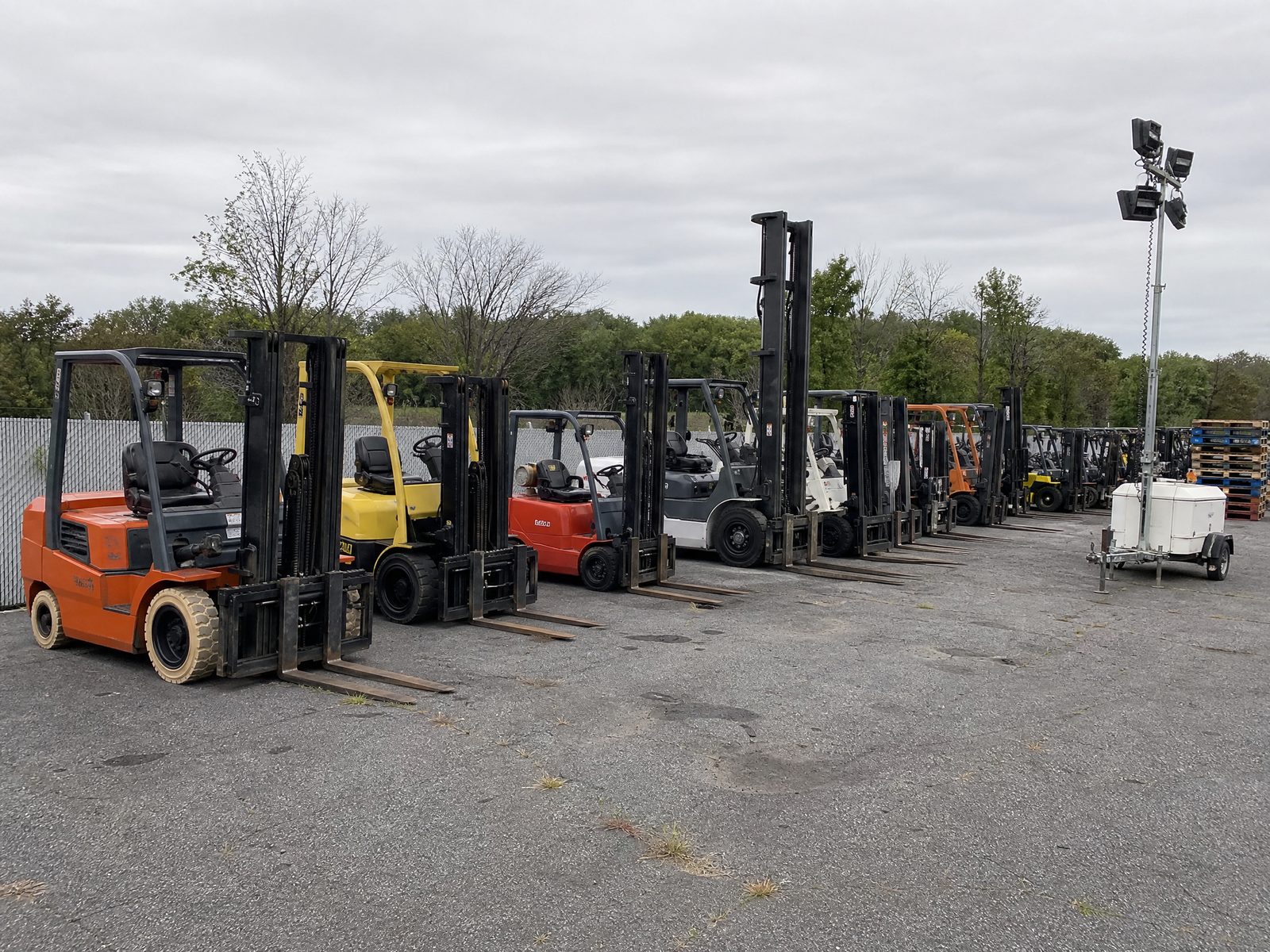
Many dealers keep us on call precisely to avoid that cycle. Send a list with photos, get one number for the group, take payment upfront, and have the lot cleared on a schedule you set. No retail effort, no auction fees, no transport arrangement, and no negotiation per unit.
It also changes what you can do on the front end. Knowing you have a reliable wholesale floor for anything you take in lets you be more aggressive on trade allowances to win new-equipment deals, because the exit is already priced.
Mixed groups are ideal: propane and diesel sit-downs, electric riders with tired batteries, reach trucks and order pickers, walkie pallet jacks by the row, telehandlers, and the odd rough terrain unit. We also buy attachments, chargers, spare battery packs, and racks of forks in the same transaction.
Condition is not a filter. Running, hard-starting, and dead all get priced. Units that failed a PDI and units nobody wants to spend another technician hour on are exactly what a wholesale buyer is for.
Send a spreadsheet or even just a text thread of photos — make, model, capacity, hours, fuel type, and a one-line condition note per unit is plenty. We price the group the same business day, payment goes out on acceptance, and our carriers stage pickups around your operations. Recurring quarterly clear-outs are common and become routine after the first one.
Send photos and the data plate. We price it and send a written offer with freight included the same business day.
A practical breakdown of how used forklift values are actually calculated — capacity, fuel type, hours, mast, tires, brand liquidity, attachments, and condition.
Read guideWhy scrap weight pricing leaves thousands on the table on used forklifts, and how machine-level valuation works differently.
Read guideThe exact shot list professional forklift buyers need, and the four photos sellers almost always forget.
Read guideBefore the truck leaves. Payment goes out once you accept the offer and we confirm pickup details — wire, company check, or cash depending on the size of the deal and your preference. We do not work on consignment, we do not pay after resale, and we do not renegotiate at the dock. The number you accept is the number you receive.
Both. One forklift sitting behind a shop is a perfectly normal transaction for us and we treat it the same way we treat a forty-unit deal: firm offer, payment upfront, freight on us. Fleets are where the largest dollars are, but a single unit is never too small to be worth a call.
Yes. A dead or missing battery changes the number, never the willingness to buy. Lead-acid packs carry core value even when they no longer hold a charge, and the truck itself is what most buyers want. If you still have the charger, include it — chargers add real money and we will take them in the same load.
All of them. Toyota, Hyster, Yale, Crown, Raymond, Caterpillar, Clark, Mitsubishi, Nissan, UniCarriers, Komatsu, Linde, Doosan, Hyundai, Jungheinrich, TCM, Daewoo, Taylor, Hoist, Kalmar, Combilift, Landoll, JLG, Genie, SkyTrak, Sellick, Big Joe, EP Equipment, and the obscure and discontinued names too. Older or off-brand iron is often worth more than sellers expect precisely because parts support has dried up and used units are the only source.
Yes. Side shifters, fork positioners, rotators, carton clamps, paper roll clamps, drum handlers, extended forks, and man baskets all have their own market. So do battery chargers, spare battery packs, and racks of forks. If you are clearing a maintenance area, tell us what is on the shelves — we regularly buy attachments and chargers in the same transaction as the trucks.
A scrap yard pays by the pound for steel. We pay for the machine as a machine — its make, model, capacity, hours, mast, attachments, and rebuildable components. On a running truck the difference is frequently several thousand dollars, and even on a dead unit our number generally beats scrap because the drivetrain and mast retain resale value that a shredder ignores. You also skip paying a hauler, since our freight is free.
That is our specialty. Mixed lots of any composition — propane sit-downs, reach trucks, order pickers, a wall of walkies, a telehandler, scissor lifts, racking-adjacent equipment — priced as one package with one payment and a coordinated pickup schedule. We work with facility managers, liquidators, and auctioneers on deadline-driven closures and can stage removal around your last day of operations.
Constantly, and many dealers keep us on standing call. Trade-ins that will not retail, aged inventory tying up floor space, units taken on allowance that do not fit your mix, and rental retirements. We buy them in bulk, pay upfront, and clear your back lot without you having to retail or auction anything.
Still buyable. A blown engine, seized transmission, dead hydraulic pump, or cracked mast rail is a line item in our valuation, not a disqualification. Be specific about what failed so the offer is accurate the first time and there is no adjustment later. Trucks with major mechanical faults are a routine part of our volume.
Yes. Telehandlers are among the strongest-value machines we purchase — JLG, Genie, CAT, SkyTrak, Lull, JCB, Manitou — and we buy scissor lifts and boom lifts alongside them, particularly from rental fleet retirements and contractors downsizing after a project. Include attachments like buckets, truss booms, and platforms in your photos.